

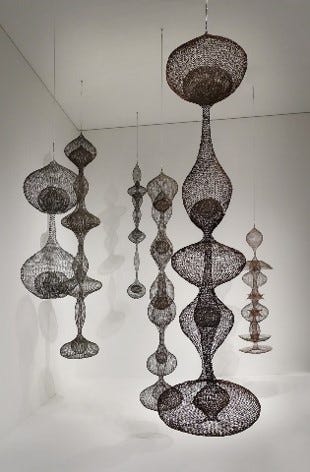
On the sixth floor of the Museum of Modern Art, Ruth Asawa’s wire sculptures hang like breaths made visible, loops of brass and light suspended between earth and heaven, quiet reminders that beauty can still be a civic language. They sway almost imperceptibly as visitors move through the gallery, casting shadows that ripple across the white walls. The effect is serene and public all at once: a choreography of discipline, patience, and grace. Each loop of wire is hand-woven, continuous and unbroken. Step closer and you see the human labor inside the geometry – evidence of time and attention in a culture allergic to both.
Ruth Asawa: A Retrospective, jointly organized by the Museum of Modern Art in New York and the San Francisco Museum of Modern Art, gathers more than 300 works spanning five decades of artistic production. The exhibition is far more than a historical survey; it is a civic revelation. In a moment when contemporary art often trades in irony, provocation, or despair, Asawa’s work stands as a counter-tradition of constructive joy. Her art is not rebellion but repair. It embodies the conviction that beauty, education, and community are inseparable threads in the democratic fabric.
Formation and Discipline
Asawa’s life story is as American as it is extraordinary. Born in 1926 to Japanese-American farmers in Norwalk, California, she was sixteen when her family was forced into internment camps during World War II. Her father was arrested by the FBI in February 1942; the rest of the family was first held at Santa Anita racetrack, then sent to Rohwer War Relocation Center in Arkansas. The experience could have produced bitterness. Instead, she found order and solace in pattern and repetition. In the camp she began to draw; after the war she enrolled at the legendary Black Mountain College, where she studied under Josef Albers and Buckminster Fuller.
Albers taught design as moral formation. “Art is revelation instead of information,” he believed – a philosophy that to see clearly was to live rightly, that perception itself was a civic virtue. Asawa absorbed that ethic completely. She would later write, “An artist is not special. An artist is an ordinary person who can take ordinary things and make them special.” That conviction shaped her life and teaching. For Asawa, art was education, and education was the moral architecture of democracy.
The lessons of Black Mountain followed her west. What she learned in Albers’s classroom – discipline, patience, respect for material – she transformed into an art that united craft and contemplation. Her San Francisco home doubled as studio and classroom; children threaded wire beside her while neighborhood students dropped in to learn. The line between life and art, between family and form, simply dissolved.
The Geometry of Community
Her signature looped-wire sculptures – those floating volumes of air and light – grew from a basket-weaving technique she learned in Mexico in 1947, during a summer trip while studying at Black Mountain College. Using ordinary materials – galvanized steel, brass, copper – she built intricate lattices that feel at once mathematical and maternal. Each loop encloses and releases space, creating inside and outside simultaneously. “I’m not so interested in the expression of something,” she once said. “I’m more interested in what the material can do.”
Standing beneath these forms at MoMA, one senses a rare harmony between intellect and humility. They are rigorous yet tender, abstract yet profoundly human. Their calm precision offers an antidote to the noise of the age. Where much contemporary art insists on confrontation or spectacle, Asawa’s insists on coherence. She understood that art’s highest purpose is not to shock but to order, not to dazzle but to dignify.
Some critics mistake Asawa’s serenity for retreat, her discipline for decorum. Yet in her patience there is protest: a quiet refusal of cynicism, haste, and the hollow virtue of outrage. Each loop of wire is an act of faith that connection still matters, that emptiness can hold form.
From Studio to City
That ethic carried beyond the studio. After settling in San Francisco, Asawa turned her attention outward – to fountains, plazas, and public schools. Her Andrea Fountain (1968) at Ghirardelli Square, with its entwined mermaids and sea forms, invites children to play and touch. Her San Francisco Fountain (1973) near Union Square, covered in hundreds of cast-bronze reliefs depicting the city’s neighborhoods and workers, transforms the everyday into civic monument.
In contrast to the forbidding monumentalism of mid-century public art, Asawa’s civic works are intimate and participatory. They do not impose; they invite. Where Richard Serra’s Tilted Arc divided Manhattan, Asawa’s fountains bind communities together. Her art exemplifies what might be called a civic modernism of belonging; an art that joins beauty to stewardship.
MoMA’s retrospective restores this dimension. Models, sketches, and archival photographs of her public commissions line the galleries, revealing an artist who saw no hierarchy between fine art and civic architecture. For Asawa, the city itself was a canvas of relation and, powerfully, a place where form could teach virtue.
Education as Civic Renewal
Of all her legacies, education may be the most enduring and this was featured potently in the retrospective. During the 1970s and ’80s, as arts programs were disappearing from public schools, Asawa became a tireless advocate for creative education as civic necessity. She organized community workshops, wrote curricula, and lobbied the San Francisco Board of Education to establish a public arts high school. Her decade-long effort culminated in the founding of the San Francisco School of the Arts in 1982 – now renamed the Ruth Asawa School of the Arts.
She believed that learning to see was the beginning of learning to care. In an era when politics increasingly substitutes for pedagogy, her conviction that creativity undergirds citizenship feels newly urgent. A society that neglects the arts, she understood, erodes the habits of attention and patience that self-government requires.
At a time when art and music programs are again the first casualties of budget cuts, Asawa’s legacy reminds policymakers that aesthetic formation is civic formation – that to teach beauty is to teach democracy.
Against Spectacle
The exhibition also offers a quiet rebuke to the art world’s current obsessions. Where so much contemporary work aims for shock, Asawa sought equilibrium. Her practice rejects the assumption that seriousness demands despair. She built beauty, not irony.
Her fountains were not luxury goods for collectors but instruments of civic play. Her wire forms were not slogans or identity statements but expressions of shared discipline. The retrospective’s curators, Cara Manes and Janet Bishop, wisely resist framing her as a rediscovered “outsider.” Instead, they present her as a peer of Albers, Calder, and Eva Hesse – an artist who expanded modernism’s vocabulary by rooting abstraction in the everyday.
Her legacy forces a question: what if public institutions embraced her ethos? What if beauty and stewardship, not branding and outrage, guided our cultural life? That MoMA, the most visible museum of modern art, now devotes its sixth floor to her work is itself an act of civic correction; a recognition that rigor and gentleness are not opposites but allies.
Transcendence in the Everyday
The quieter rooms of Ruth Asawa: A Retrospective reveal the artist at rest. Watercolors of wilted poppies, contour drawings of her children, geometric studies in ink – all bear the same meditative rhythm as her wire sculptures. There is something almost liturgical in their repetition, as if each line were a small prayer for coherence.
The show’s through-line is unity: between sculpture and sketch, between home and public space, between the hand that loops wire and the city that receives its pattern. “Art is doing. Art deals directly with life,” she said. Those words capture the civic heart of her vision—an understanding that attention itself is a form of creation.
A Civic Vision for Our Time
Asawa’s worldview was never narrowly aesthetic. It was civic, even constitutional. She believed that the virtues of making – patience, discipline, care – are the same virtues that sustain a democracy. Her life offers a model of citizenship rooted in creation rather than consumption.
That insight speaks directly to the crises of our own moment. Polarization has replaced participation; distraction has replaced devotion. Yet Asawa’s example reminds us that civic trust is built the same way a sculpture is: one loop at a time, each joined to the next. When students learn to draw, weave, or fold, they are also learning how to see one another
The Republic of Beauty
In the film that concludes the exhibition, Asawa leads a classroom of children in a paper-folding exercise. Their faces brighten as flat sheets rise into complex geometries. “You can make something beautiful out of almost anything,” she tells them in the film. It could be her epitaph or a creed for public life.
For Asawa, beauty was not ornament but ethic: the visible sign of care, the trace of faith that the world can still hold form. Her retrospective is more than an art event. It is a moral reminder that beauty is a public duty.
Standing in MoMA’s final gallery, as the wire forms shimmer and sway, one senses not nostalgia but instruction. The work teaches us how to look, how to care, how to build. It suggests that beauty, like democracy, is not a finished product but a practice – looped, patient, participatory, and unbroken.
In the fragile republic of art and citizenship alike, Ruth Asawa remains our most luminous teacher – showing that to make something beautiful is to believe, however quietly, that the world can still be made whole.
Samuel J. Abrams is professor of politics at Sarah Lawrence College, a senior fellow at the American Enterprise Institute, and a member of the Civic Life advisory council.
This essay was originally published in newgeography on December 1, 2025.

Fantastic! I love this interpretation of an amazing exhibit.