

A republic depends decisively on the norm of public truth telling. Without it, there is no foundation for mutual trust or for the responsible negotiations that make our democratic way of life possible. For this reason, public lying is arguably the worst possible offence against a society founded on the principle of self-government.
Which brings us to the story of a photograph.
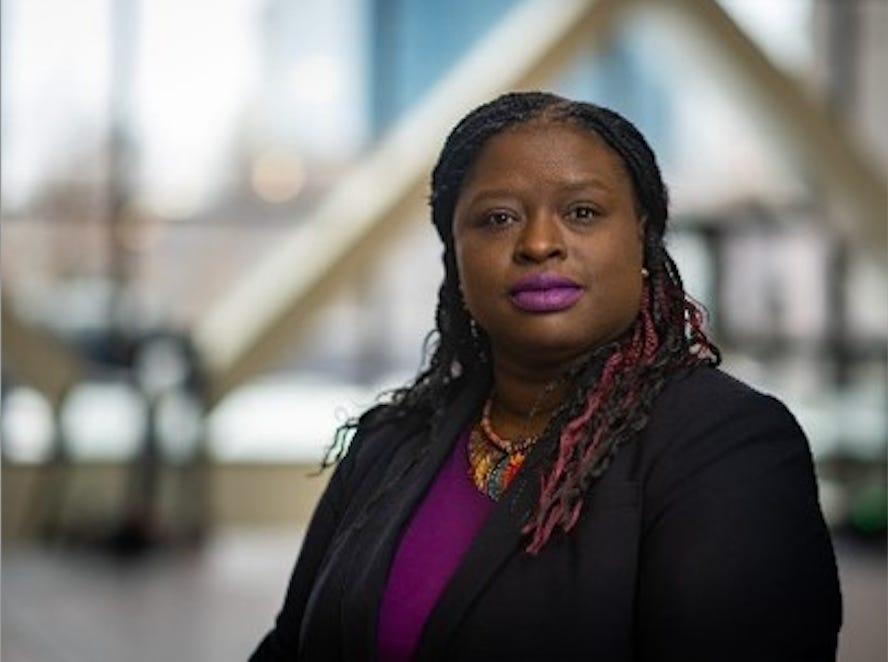
On January 22 in Minneapolis, federal agents arrested Nikema Levy Armstrong, a local African-American civil rights leader. She was arrested for her role earlier that day in a protest against the presence and conduct of Immigration and Customs Enforcement (ICE) deportation officers in her city.
That same day, the White House posted and circulated a digitally manipulated photograph of her, done in order to make her look weak, fearful, and uncomposed. (The actual, unfalsified photo conveys the opposite qualities in her appearance.) Later, White House spokesperson Kaelan Dorr defended the use of the doctored photo and promised more to come, calling the falsified Armstrong photo a “meme” and stating plainly: “The memes will continue.”
A crucial line just got crossed.
First, this occurrence appears (no pun intended) to be the first time in our nation’s history that a president or a president’s administration has deliberately altered photographic evidence to demean an American citizen for political purposes.
The Administration’s defenders can reply that altering photographs is nothing new, and they are right. Today millions of us use Photoshop to make our pictures more appealing, and each time we do, we alter an original photograph. Many people today also create so-called memes in which photos are altered in order to appear funny or communicate sarcasm.
But the falsification of Nikema Levy Armstrong’s facial image on the day she was arrested was not done by ordinary citizens to make her look more attractive or tell a funny joke. It was done by the highest officials in the land to deceive the public about a possible crime and inflict intentional harm on an American citizen. This has not happened before, and we can thank Heaven for it.
We also learn from this episode that arguably the worst form of public lying is corrupting our visual understanding -- our capacity as citizens to make intelligent use of our own eyes.
Why? Because much scientific evidence suggests that, for humans, seeing is prior to interpretation. Our initial access to the world comes primarily through our eyes. That’s why we say that “seeing is believing” and why saying “I saw it with my own eyes” is more convincing than, for example, “I heard it with my own ears.” Among humans, vision dominates cognition. First and mainly we see it, then we try to make sense of it.
Authoritarian political leaders have long understood and acted on this fact. In the former Soviet Union, Communist rulers regularly doctored official photographs, including the removal of people’s images entirely, because they knew erasing adversaries visually is longer-lasting and runs deeper than simply disparaging them with words. Today, the similarly authoritarian Russian government regularly deploys manipulated photos and videos as part of information warfare campaigns in the Baltic states, Ukraine, and elsewhere.
Hannah Arendt, the great student of totalitarianism, tells us that the ultimate aim of the totalitarian system is not to convince you that its lies are true, or even to force you to treat them as true when you know that they are not. The ultimate goal is to disorient you so thoroughly that you no longer feel able rationally to distinguish fact from fiction.
What’s the best strategy for achieving this state of affairs? It’s to disable me visually -- to put me in a world where I can no longer trust my own eyes. Am I looking at the face of Nekima Levy Armstrong? Maybe, maybe not. I have no way of knowing. I can no longer see my way.
In any society, this form of assault is terrible. In a republic, it’s potentially lethal. Public truth-telling, a necessity for self-governing people, effectively loses its meaning when citizens can no longer reliably judge what is true and what is false.
This is how free societies become unfree.
That’s why, even in today’s noise and haste, when news flies by so quickly that we feel unable to give anything the attention it deserves, all of us ought to take a moment, for the sake of our republic, to look carefully at the actual face of Nekima Levy Armstrong.
What else? The Administration should reconsider its stated intention to continue the practice of manipulating photos for political purposes, and instead conduct a review of this episode, with the goal of new, publicly stated pro-truth guidelines to highlight the ethical and civic issues involved and improve practices in this area across society. The vast majority of Americans would support and admire this form of public leadership.
More broadly, we can learn from the pioneering work now taking place in Estonia and Ukraine. This work includes a comprehensive approach to teaching school children how images can be falsified, television programs devoted to exposing examples of manipulated images and videos, and mobilizing journalists and others in civil society to adopt and improve effective strategies for visual verification.
Relatedly, we can support the work of organizations such as the News Literacy Project, which works in the United States, and WITNESS, which works globally.
We have leaders who know what to do. The next and most important step is for America as whole to decide that this issue is vital to our civic life.
A version of this essay was published in the Deseret News on February 22, 2026.
For an actual, undoctored recent photo of Ms. Armstrong, as well as the falsified photo, see “White House Posts Photo Altered to Show Arrested Minnesota Protester Crying,” New York Times, January 22, 2026.