

Note: This is the second of three essays by Samuel Abrams focusing the lives of important contributors to American civic aesthetics -- creators who have shown us how the arts and the built environment can enrich the formation and practice of civic life. (Here is his first essay.) This is an important topic, and one to which we’ll return.
Two titans of American architecture — Frank Gehry and Robert A.M. Stern — have passed within days of each other. Gehry died at 96 in Santa Monica, Stern at 86 in Manhattan. Their departures close a defining chapter in American design, but they also open an opportunity to reconsider what we expect from our cities, our institutions, and the built environments that shape civic life.
Their careers unfolded in completely different registers. Gehry was the disrupter: the Toronto-born, Los Angeles-forged rebel who discovered emotional electricity in chain-link fences, corrugated metal, sun-bleached stucco, and the digital tools that eventually allowed him to twist steel into improbable billows. Stern was the historian and builder of context: a Brooklyn kid who fell in love with New York’s limestone behemoths and marble-clad entryways, and who spent half a century arguing that tradition could be renewed rather than discarded. Yet despite their differences of temperament and technique, they shared an unusual seriousness about architecture’s civic purpose. Both believed that buildings could elevate ordinary life, strengthen our sense of belonging, and make cities more humane.
I remember seeing Gehry’s earliest plans for the Guggenheim Bilbao when I was a teenager in New York. I didn’t yet know the theoretical vocabulary — I wasn’t thinking about deconstructivism or parametric curves — but the image stopped me. The museum’s titanium looked like it was alive. It didn’t sit on the riverbank; it unfurled onto it. The forms seemed to be moving even as the building stood still. Until then, buildings had been objects. Bilbao was an event. It showed me for the first time that architecture could make you feel something unexpected and, frankly, joyful — and that public space could carry that emotional charge.
For Bilbao, Gehry took a dying industrial waterfront — a landscape of rust, soot, and shuttered factories — and turned it into the global shorthand for urban renaissance. The so-called “Bilbao effect” was often mocked by critics as a faddish, simplistic formula, but the underlying lesson was more profound: cities can be revived not only through infrastructure and zoning, but through beauty, risk, and ambition. Whether one loves or hates Gehry’s sculptural exuberance, he proved that a single building, properly conceived, can shift a city’s trajectory. In the decades since, many cities have learned the wrong lessons, erecting loud buildings that imitate the surface spectacle without the deeper logic. Still, Gehry’s achievement remains singular. His work insisted that cities owe citizens not merely functionality but delight — an underrated civic virtue.
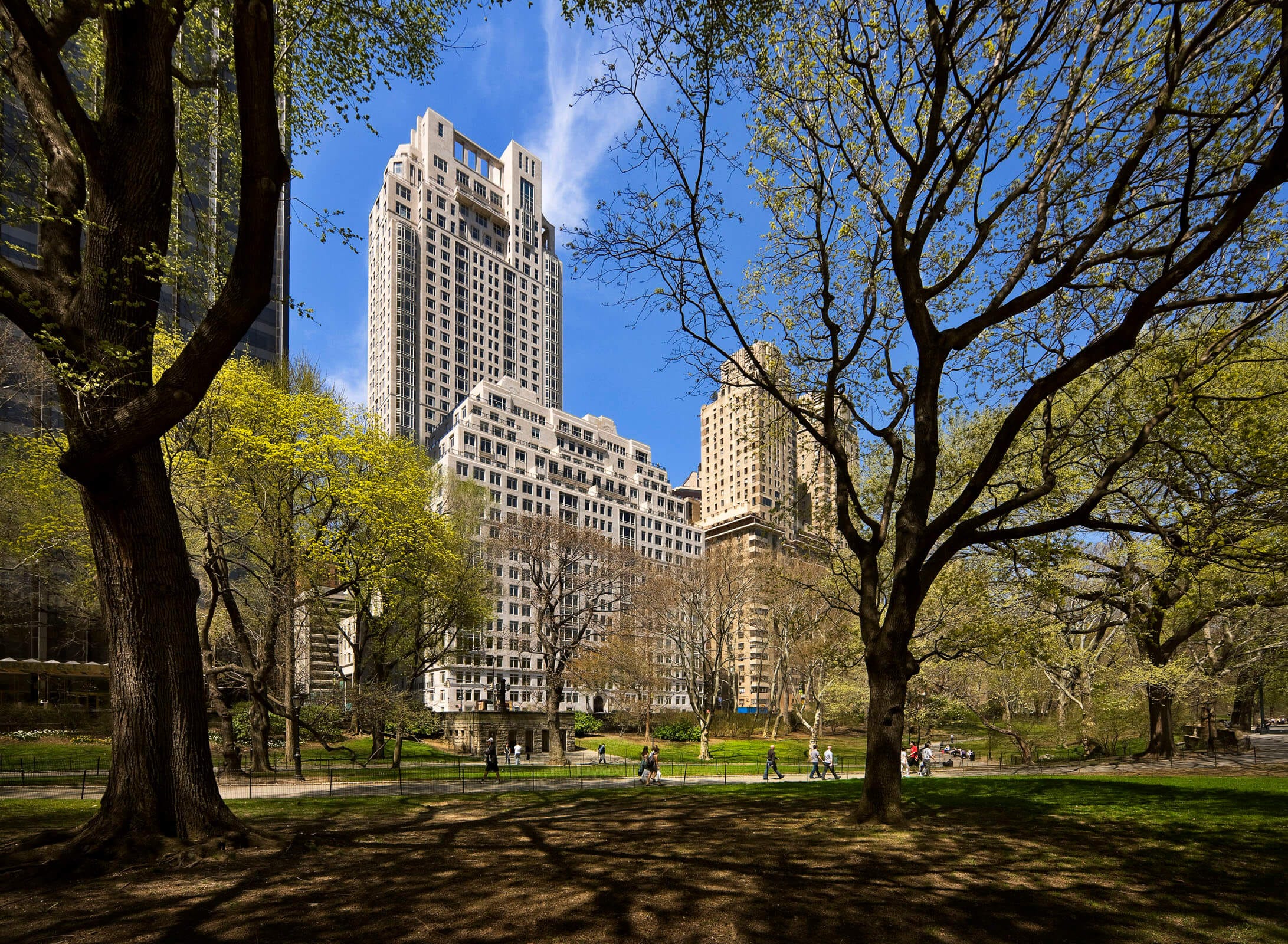
Stern worked from the opposite direction. He believed deeply in continuity, in the idea that cities accrue character over time and that good architecture participates in that long story rather than bulldozing it. Long before he became famous for 15 Central Park West, he spent decades designing unflashy but dignified dormitories, libraries, museums, and civic buildings that understood their settings. He believed that architects had a duty to engage context, not ignore it.
Stern’s 15 Central Park West — two limestone towers, one modestly scaled on the park and the other taller and set back, joined by a copper-domed rotunda and a civilized motor court — was a rebuke to the anonymous glass towers that had overtaken Manhattan. Critics noted that the building seemed to belong to an older era of New York civic confidence. Buyers flocked because it felt familiar yet new, rooted yet polished. It was Stern’s breakthrough, but its real significance was that it restored respect for the prewar vocabulary that had made New York legible in the first place. Where Gehry reimagined the future of form, Stern reasserted the value of memory.
Stern’s civic projects — the George W. Bush Presidential Center in Dallas, the Museum of the American Revolution in Philadelphia, the Norman Rockwell Museum in Stockbridge — all followed the same quiet principle: people deserve buildings that treat them as participants in a story. His work argued that tradition is not nostalgia but a democratic inheritance. For Stern, the past was not an anchor holding the city back; it was a set of tools for creating places people would actually love.
It is tempting to reduce Stern and Gehry to opposing poles in a culture war: classicism versus deconstruction, hand drawing versus computer modeling, limestone versus titanium. But that framing floats above the more meaningful truth. Both were reacting against the same problem: the thinness of modernism when abstract ideology overrides human need. Stern criticized the modernist tendency to produce “self-important objects” with no relationship to their surroundings. Gehry recoiled from the antiseptic perfection of high modernism — the polished pavilions that he felt were “effete” and incompatible with the messy vitality of real life. Both men, in their own ways, rejected purity. Both cared about people first.
Their shared conviction — that architecture is a civic art, not an academic exercise — matters now more than ever. We are living through a period of deep institutional fragility. Students arrive on campuses anxious and lonely. Cities, especially legacy metros, are grappling with empty office towers, transit strains, unaffordable housing, and weakened civic confidence. Too many new buildings are interchangeable glass commodities, equally at home in Seoul, Austin, or Midtown Manhattan. Too many public spaces look like corporate lobbies: frictionless, placeless, and forgettable.
Gehry and Stern provide a counterpoint. They remind us that buildings teach. A well-designed campus signals order, purpose, and seriousness. A museum that welcomes people with beauty rather than intimidation suggests that civic life is meant to be shared, not siloed. A neighborhood that respects its past invites trust and affection. A city that takes risks on public art, unusual forms, and emotional resonance gives residents reasons to care.
Both architects also demonstrated that taste is not trivial. When a city builds well, it dignifies the people who live in it. When it builds poorly, it signals indifference — or worse, contempt. This is especially evident in the fabric of American suburbs and small cities, where too many civic buildings are designed like budget hotels and too many commercial centers are anonymous boxes surrounded by parking lagoons. Gehry and Stern would have disagreed about the right materials or forms for these places, but they would have agreed that the task is honorable, that residents deserve something better than the purely expedient.
Their deaths also invite a reflection on the American habit of oscillating between opposites: between nostalgia and novelty, between aesthetic puritanism and architectural spectacle. Stern and Gehry suggest a more mature direction. Continuity and reinvention need not be enemies. A city can honor its historical grain while still experimenting with new shapes, materials, and technologies. A community can build traditional civic buildings without sliding into pastiche, and can build expressive modern structures without turning them into billboards for developers. The question is not old versus new, but whether the result strengthens the civic realm.
When I think back to seeing the Bilbao plans as a teenager, what struck me wasn’t the novelty but the possibility. When I think now of Stern’s work — the way 15 Central Park West fits Manhattan’s skyline without disappearing into it — I think about the power of restraint. Cities need both impulses. They need imagination and memory, ambition and modesty, the courage to shock and the wisdom to calm.
That balance is painfully rare in contemporary planning debates. Our arguments about zoning, density, and housing often reduce buildings to units, envelopes, and FAR calculations. These are essential elements of policy, but they are not the whole story. A city that builds only for efficiency will eventually erode its own identity. A city that builds only for spectacle will eventually exhaust itself. Gehry and Stern, each through decades of work, showed that civic architecture is most powerful when it is clear about its purpose: to make the shared world feel worth belonging to.
Their deaths are reminders, not just losses. They urge us to demand more of our public spaces, our institutions, and our cities. They ask us to look up — literally — and to let architecture rekindle our sense of possibility. America has no shortage of challenges, but we have also inherited a remarkable toolkit: the imagination of Gehry, the discipline of Stern, and a tradition of building that once took citizenship seriously.
The question now is whether we still have the will to use it.
Samuel J. Abrams is professor of politics and social science at Sarah Lawrence College and a member of the Civic Life advisory council.
This essay was originally published in newgeography on December 8, 2025.
